Community Colleges Play a Vital Role in Increasing Food Security
Originally published on Substack 2.25.2026
Community colleges have played a vital role in the continuing education of individuals in the United States, whether we’ve understood their significance or not. With the rising enrollment rates of community colleges and with 39% of college enrollment represented at the community college level, their significance to our overall health and well-being is being understood by many more people. Their role in our lives means affordable continuing education, and through the partnership Food Recovery Network (FRN) has had with our community colleges across the United States, so much more.
Food Recovery Network is a national movement grounded by over 220 college student chapters with thousands of college students and faculty across the U.S. working to increase food access in local communities. For 15 years, we’ve grown our network to include over 8,000 active participants across all food sectors, including volunteers and food businesses.
Technical and community colleges function differently from the four-year colleges that have historically driven our movement. When we applied our unique data-driven maps to determine how we can feed more people, faster, we knew we had to collaborate with community colleges. For the past three years, we have intentionally tailored our programming to meet the unique challenges faced by community college students and their surrounding communities, and leveraged their strengths to dramatically increase food access.
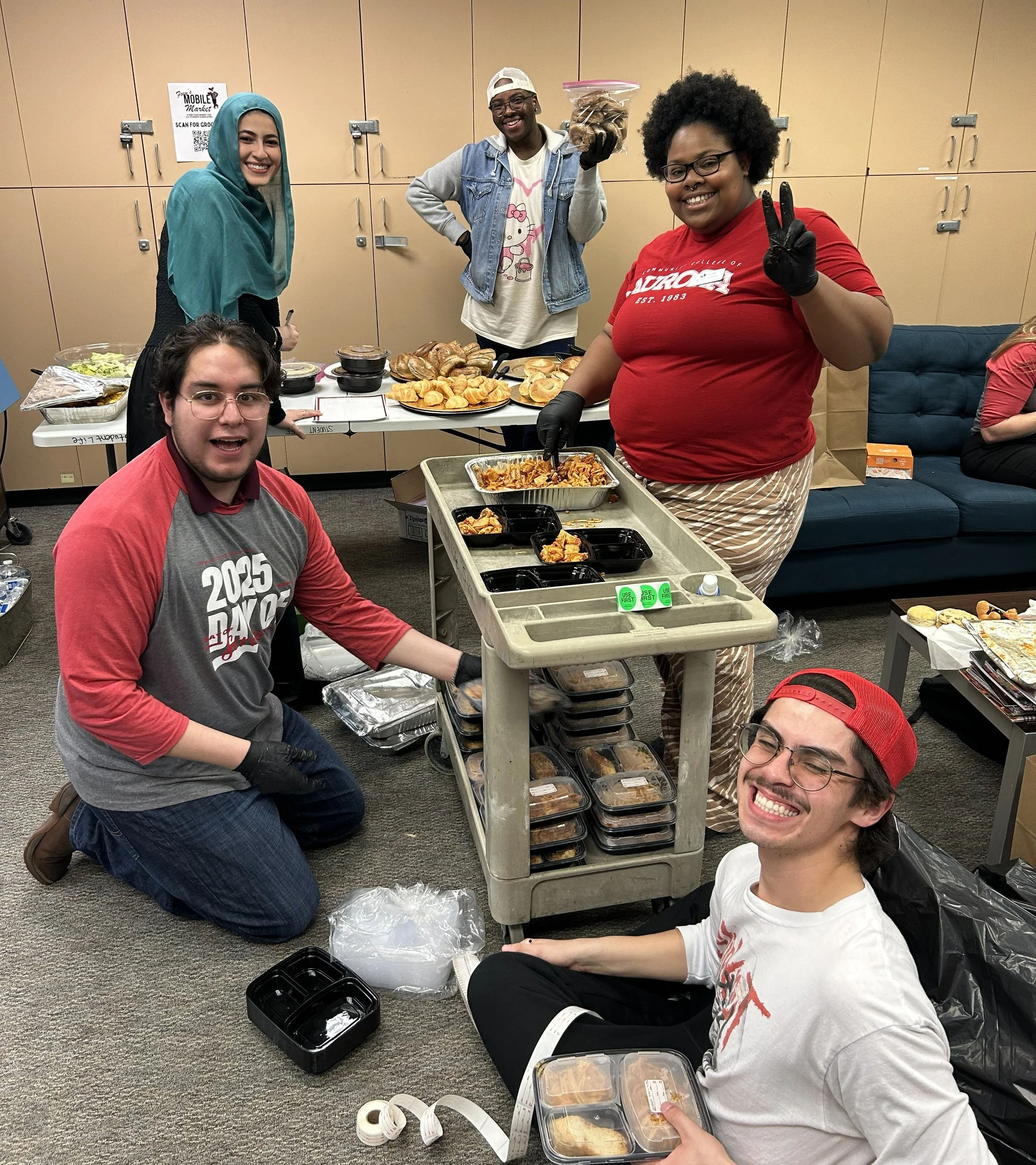
Students at Community College of Aurora, Colorado
The Problem
Community colleges receive about $8,800 less per student than four-year institutions, resulting in a staggering $78 billion funding gap nationwide. Less funding can mean fewer staff hours to help start initiatives like food recovery. Community colleges may have fewer resources to create safety nets necessary to keep students enrolled as they find themselves in a variety of life strains that make it hard to stay in school, affecting not just the student, but the whole family.
And let’s not forget that the balance of work, school, and additional family responsibilities is compounded by students’ income levels. Students themselves are often food insecure and need to look for resources to help get the food they need. While the government provides some support for food, healthcare, and housing (basic needs), it often falls short of what is truly necessary to make ends meet. Studies show that sometimes 50% of community college students may experience some form of food insecurity, compared to just under 20% of their four-year institution counterparts.
The reality is that community colleges and community college students operate with fewer resources than their 4-year counterparts, often in communities where hunger rates are higher than those of their 4-year counterparts. To address this disparity, FRN is committed to enhancing financial support and offering guidance to faculty and staff at these colleges. By initiating food recovery programs, we can collect and distribute surplus food within communities, often directly on campus, helping reduce unnecessary food waste while supporting entire communities and students who experience hunger.
Launching these programs comes with financial costs, but the investment is essential.
Program Success
Our first two community college cohorts have shown great success in recovering food and have also helped raise awareness of the benefits of food recovery and the value of having an FRN chapter on campus. In the past year and a half alone, those ten schools, together, have recovered 311,853 pounds of perfectly good, precious food. Had these recovery programs not been established, that food would have been destined for landfills, where it would have helped no one, but rather would have rotted and produced excess CO2 emissions. As we engaged the community college community in our second year, we doubled the number of applications—showing increased need and interest.
We’ve heard from many of our current cohorts that students’ concern about food insecurity has increased with the recent SNAP cuts from the federal government, such as the Community College of Aurora, Colorado, which experienced a dramatic increase in student need
“Being able to continue recovering food has been essential over the past few months, especially as many students expressed heightened concern about their ability to access enough food. The recent SNAP benefit reductions created significant instability, and the impact surfaced in nearly every conversation the program team has had…”
Unfortunately, it’s a common sentiment among all our participating community colleges. They are grateful to have begun implementing and growing food recovery on campus in time to serve the increase in students struggling to put food on their tables.
Future
We are on the verge of initiating our third year of community college grants to reach even more campuses, recover a substantial amount of food, reduce greenhouse gases by preventing food from rotting in landfills, and help level the playing field for food justice. The impact we can make in the year ahead will be exponential.
We are feeding more people faster by ensuring surplus food is distributed in a way that offers convenient access for individuals and communities experiencing food insecurity.