The #GivingTuesday #FRNdzy results are in!

The FRN National team celebrates raising nearly $13,000 through the 2015 #GIvingTuesday #FRNdzy.

The FRN National team celebrates raising nearly $13,000 through the 2015 #GIvingTuesday #FRNdzy.

To our wonderful FRNds and supporters:

A month ago yesterday, we embarked on an ambitious fundraising campaign to support our efforts to bring Food Recovery Network to all 50 states and recover the next million pounds of food that would otherwise be wasted.

Yesterday, we celebrated #GivingTuesday, a global day of giving and the apex of our month-long #FRNdzy fundraiser. 

Today, we are awed of the outpouring of contributions from supporters like you -- active members of communities nationwide, who want to make food recovery the norm rather than the exception.

Thanks to you, we raised nearly $13,000 to help us work toward our goals.

With $13,000, Food Recovery Network can recover 13,000 meals! That’s enough to feed a family of four for three years. 

We are so grateful for the generous support of our donors and our awesome student leaders who help us channel these resources into impact.

The Real Cost of Food

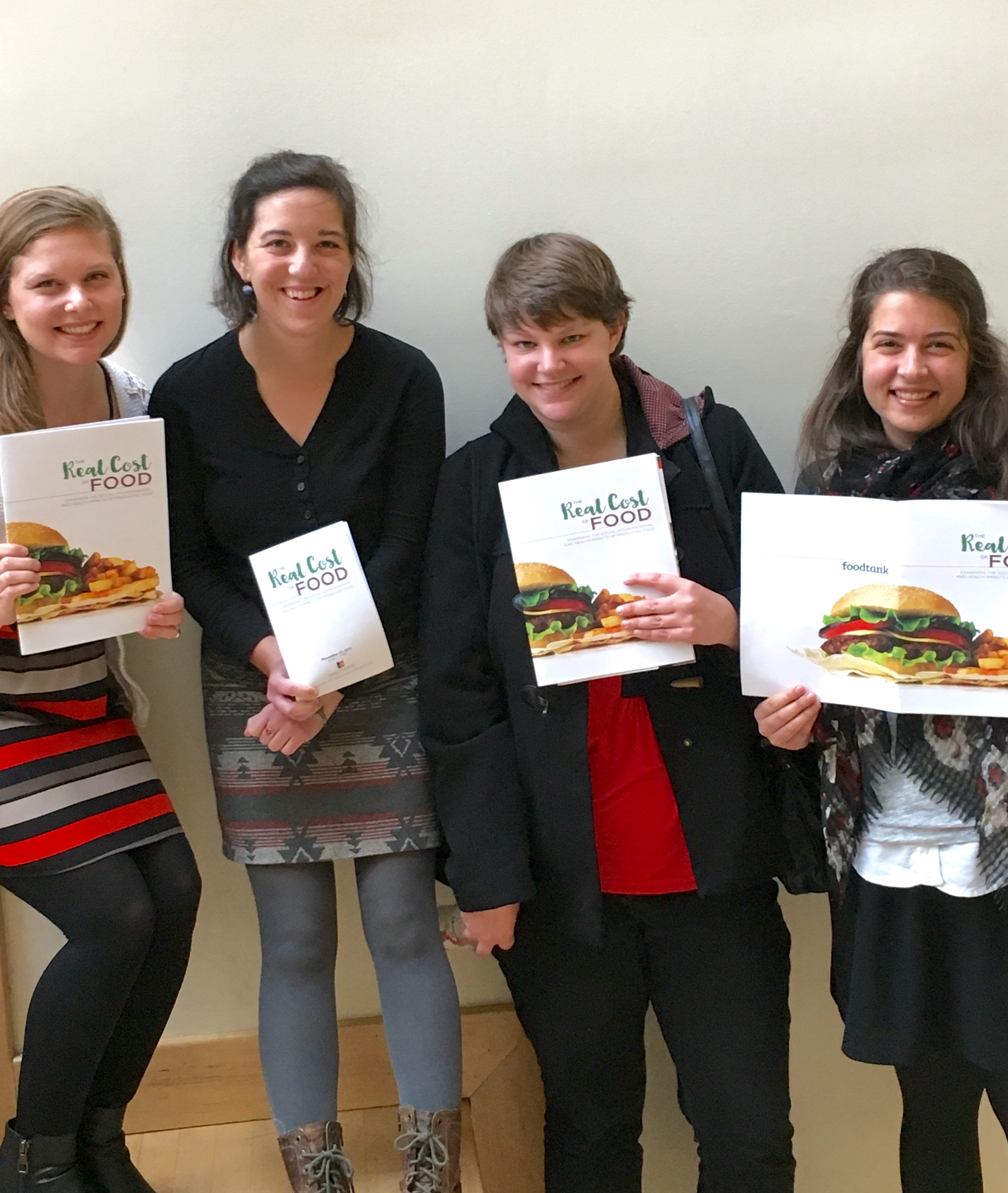
Jamie, Sara, Erin, and Leyla stop for a photo at the "The Real Cost of Food" at American University.

Jamie, Sara, Erin, and Leyla stop for a photo at the "The Real Cost of Food" at American University.

What if you went to your favorite fast food chain for a hamburger and the price you paid included the cost of treating Americans for heart disease, the cost of environmental restoration from manure runoff at factory farms, and compensation to workers injured in slaughterhouses? The chances of that burger making it on a dollar menu are pretty slim.

The concept of assigning value to the social, environmental, and health impacts of producing food is called True Cost Accounting. Three other member of FRN's national staff and I were lucky enough to attend a special event hosted by Food Tank called “The Real Cost of Food”, which explored this concept. Held at American University, the session consisted of two keynote speakers and a panel of experts in the food and agriculture industry.

They spoke about agriculture in the United States in terms of everything from food waste to eating local versus organic to climate change to animal welfare and beyond. While each statement felt more powerful and thought-provoking than the last, two speakers shared ideas that really stood out. 

The first came from Barbara Ekwall of the Food and Agriculture Organization of the United Nations, who spoke about food waste. Ekwall used a powerful analogy to help the audience understand how significantly the issue of food waste affects the planet.

If food waste were a country…
It would be the largest user of irrigated water.
It would be the second largest country after the Russian Federation.
It would be the third largest emitter of greenhouse gases.
It could feed two billion people.

Wow.

The second idea that really stuck with us came from Paul Shapiro, Vice President of Farm Animal Protection at The Humane Society of the United States. Shapiro spoke about the horrors of factory farming and how concentrated animal feeding operations have engaged in a “moral race to the bottom”, choosing mass production over animal welfare. Unfortunately, animals are not the only ones that suffer from the cruel practices that allow for the vast amount of meat that Americans consume each year. Human health and the health of our environment are also largely impacted.

One quote from Shapiro summed up his stance and provided an important takeaway for the entire event:

“Eating is a moral act. We can choose foods that help us or we can choose foods that hurt us.”

So next time you are at the grocery store, please take a moment to consider the implications of the food you buy. If we as consumers increase the demand for fruits and vegetables and other healthy foods that are grown and processed in an ethical fashion, we will be met with a greater supply of those foods. In that way, each of us can help positively influence the agricultural industry, one meal at a time.


A huge thanks to Food Tank, the Union of Concerned Scientists, GRACE Communications Foundation, and American University for putting on this event! To find out more about the real cost of food, check out the report that inspired this event.
Giving Thanks for our FRNds

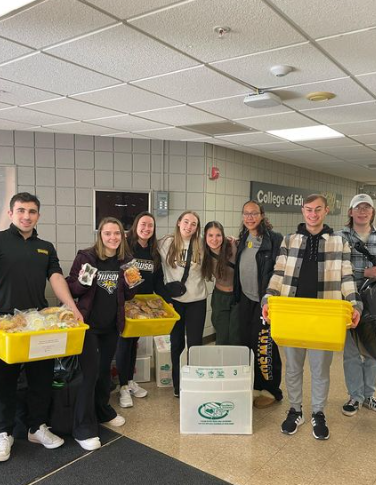
Students at Madonna University work with their university dining services to recover and donate food to Life Challenge in Detroit, Michigan. 

Students at Madonna University work with their university dining services to recover and donate food to Life Challenge in Detroit, Michigan. 

Thanksgiving week is upon us, and here at Food Recovery Network we have a lot to be grateful for. 

We are grateful for our 160 chapters in 39 states. These student leaders and volunteers have recovered more than 1 million pounds of surplus food from their campus communities that otherwise would have gone to waste. Thank you for your leadership and dedication.

We are grateful for our partner agencies. These community organizations across the country work hand in hand with our student leaders to make sure recovered food ends up on the plates of those who need it most. Thank you for your partnership and service. 

We are grateful for our dining hall and restaurant partners. These eateries go the extra mile to donate their surplus food rather than throw it away. Thank you for your initiative and commitment. 

One of FRN’s core values is reflection, so I’d like to take some time to reflect on the past four years by sharing some stories of gratitude from those involved in FRN’s journey.

From a student: “After we made our second recovery, I received a call from our contact at our partner agency. He took time out of his Saturday to call and tell me how grateful they were at Life Challenge to be receiving these donations. He said that he had told the residents that they received these donations from students at Madonna University and they were all excited to know who we were! Consistently after that, he always makes sure that we know that they use all the food and the residents are very thankful. After that moment, I knew this was all worth it! I am so glad we are participating with FRN and making this difference in our little corner of the world.” -- Katie Crombez, President of FRN at Madonna University

From a partner agency: “Food Recovery Network is remarkable not only for the array of wholesome food they donate to us, but for the spirit of the students who work with us. In the high-pressure environment of a major college (Providence College), students finding the time and the desire to serve their community is inspiring. … Their donations are invaluable in helping us to keep feeding the people who depend on us. I’m very grateful to be part of the network.” -- Larry LoVerde, Kitchen Manager at McAuley House

From a recipient of FRN food: “I so appreciate the help of PLASE during this transition and crisis. I felt part of a family in so many ways. This did indeed include the daily meals, conversations and kindness of residents and staff. I know part of the food was donated through Goucher College. It added good and new foods. I am so appreciative."  -- Ms. K. G., a veteran served by Project PLASE 

Finally, we are grateful for our funders and donors. Your contributions help us fulfill our mission of fighting waste, feeding people, and developing student leaders. Thank you for your support and investment. 

Please consider making a donation to FRN today as part of our annual #GivingTuesday #FRNdzy fundraiser.

7 Ways to Reduce Food Waste This Thanksgiving

Thanksgiving: a time for family, friends and a whole lot of food. We get it, we love food, but when all that food becomes leftovers that no one is interested in eating, it’s a problem. We thought it might be useful to share a few pointers on how to reduce your food waste this Thursday.


Plan your menu. It may seem like a no-brainer since it’s Thanksgiving, but it’s the easiest way to reduce food waste. If you know exactly what you’re cooking or who’s bringing what, you won’t have five bowls of mashed potatoes on the table. (Even though that doesn’t sound like the worst thing that could happen.)

Get a head count. This is step two of menu-planning. If there are only eight guests coming, cooking for 20 is 1) stressful and 2) unnecessary. Knowing the length of your guest list will help you decide what size turkey to buy.

Check your cupboards. Before you head to the store, double check that you don’t have a can of this or a box of that hiding in the back of your pantry.

Keep the giblets and other bits. Did Grandma ever throw away the turkey giblets? No, she didn’t. She used them to flavor the gravy. She also probably used the pile of vegetable trimmings to make soup stock.

Let the leftovers leave. Encourage guests to bring containers so that they can take home some of the leftovers. Just be sure to keep the pie. You’ll want the pie.

Use the rest of the leftovers. Even if everyone takes home a doggy bag, you’ll probably still have something in your fridge. Get creative! There are thousands of recipes on the Internet using leftovers for post-Thanksgiving meals. No excuses.

Feed the hungry. Find a food bank in your area and donate any excess food you have.


We'd love to hear how your waste-free Thanksgiving goes. Leave a comment or send us an email at info@foodrecoverynetwork.org

International Forum for Women's Food Leadership in the Global South

(From left) Maddie, HC, Karen, Cam, Mia, and Hannah attend the International Forum for Women's Food Leadership in the Global South at GWU in late October.

(From left) Maddie, HC, Karen, Cam, Mia, and Hannah attend the International Forum for Women's Food Leadership in the Global South at GWU in late October.

This post is written by Maddie Cunninghan, an FRN Expansion Fellow for the 2015-2016 year.

Last month I had the opportunity to attend the International Forum for Women's Food Leadership in the Global South at The George Washington University with several of my FRN colleagues. Hosted by GWU's Global Gender Program, this extraordinary event brought women from diverse fields, backgrounds, and geographical locations together to share their stories of the fight to build a more just food system. 

Throughout the two days, several themes emerged that I found particularly powerful and relevant to the work FRN leaders do each day. One theme the panelists brought up many times was the need to focus on solutions, not just problems. As women from developing nations, many of the women were all too used to their country or region being used as a case study for problems like agricultural inefficiency, lack of infrastructure, or malnutrition. While these are real problems, and seeing them clearly is deeply important, the next step is to do something about them.

The female food leaders we heard from know a thing or two about doing something to create real change. So do FRN student leaders. As a New Chapter Coordinator at FRN, I get to speak with student leaders working hard to create official FRN chapters of their campuses every day.  In my mind, these students are “Food Leaders” in their own right. These students are informed about climate change, hunger, and social inequality. They see problems in their community, and they do something.  

The way FRN chapters go about making a difference is simple, tangible, and effective. They donate food that would normally be wasted to people in need. This may not tackle all of the problems related to our food system all at once, but as the fellow who took on the task of entering all of our partner agency testimonials into a new database this year I can assure you that FRN leaders are making a difference.  At one point during the conference, one of the women said “Just because it's complex doesn't mean we don't go there.” The women food leaders I had the opportunity to hear speak, and FRN leaders both prove that being informed about complex issues doesn’t have to lead to paralysis. So FRNds let’s keep moving forward, one step at a time.

For more information about the Forum, check out Food Tank's event debrief.